


King Crab
- Scientific name: Paralithodes camtschaticus
- Market name: King crab
- Common names: King crab, Red king crab, Alaska king crab
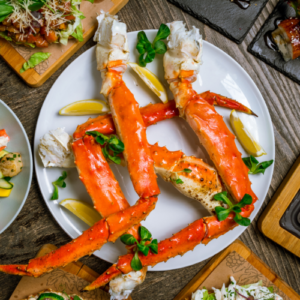
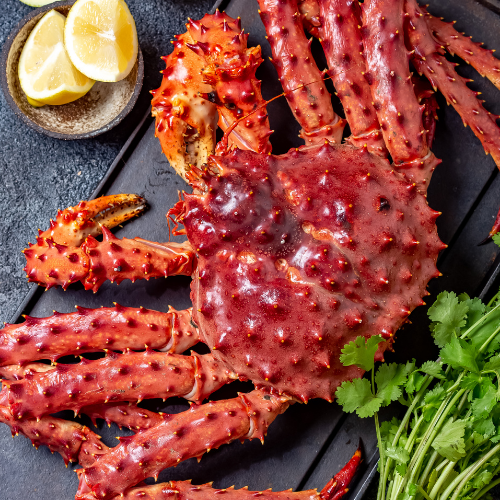
The largest of the commercially harvested crabs, king crabs are characterized by spiny shells and long, spidery legs. King crabs have 3 sets of walking legs, one large “ killer” claw an one small “feeder” claw. Shell color varies according to harvest location. While red is the most common of the king crab species, there are also blue and brown king crabs . Red is the most marketable, primarily because of size, followed by blue and then brown. King crabs are found in shallow waters off the shores of Southeast Alaska and in the Bering Sea on flat, plain-like stretches of sea floor. They are caught in large, wire-mesh traps.
Product Profile
King crab is sweet, moist and rich in flavor. The king’s body meat is slightly flakier than the leg meat. The spiky shell of the cooked carb leg is bright red and the meat is snow white with a scarlet membrane.
You should know……
It is essential to thaw king carb meat slowly – 24 shours in the refrigerator – or it will become watery and mushy. Remember that you are dealing with precooked product; do not overcook.
Nutrition facts:
Serving size: 100 g/3.5 oz. (raw)
Amount per serving
| Calroies | 74 |
| Fat Calories | 7 |
| Total Fat | 0.8 g |
| Saturated Fat | N/A |
| Cholesterol | 60 mg |
| Sodium | 70 mg |
| Protein | 15.2g |
| Omega-3 | N/A |
Cooking tips:
Kind crab meat, chunked, flaked or shredded, can be served hot or cold. For hot menu items, gentle heating is all that’s required. Add to soups and stews during the last 5 minutes of cooking. Legs are often served in the shell with drawn butter. To steam, throw legs in a covered pot with an inch of so of water, bring to boil and steam just until heated through, about 5 minutes.
- Scientific name: Chionoecetes spp.
- Market name: Snow crab
- Common names: Snow crab, Alaska snow crab, spider crab, tammer crab.
There are three species of snow crab, Opilio, Bairdi and tanneri.
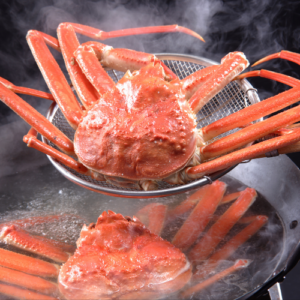
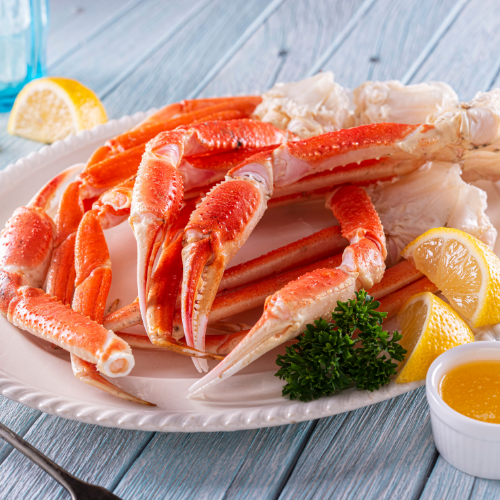
Snow crabs have four sets of walking legs, plus a pair of claws. The most important commercially is opilio, which is also the only species caught in both the Atlantic and Pacific. Snow crabs are taken in traps, from sandy bottoms. They are smaller and less red than king crabs.
Product Profile
Snow crab meat is sweet and delicate, with a more fibrous texture than king crab. Texture ranges from the tender, longitudinal fibers of shoulder meat to firmer fibers of claw meat. Cooked shell is red, thought not as red as king crab, running to brownish at the shoulder. The meat ranges from snow white to reddish.
You should know……
As snow crab ages, it can become “dirty” with black patches, barnacles and mottling(patchy and irregular colors) on its shell. This doesn’t affect the quality, but “dirty-shell” crabs can be cheaper and meatier, since they haven’t molted.
Nutrition facts:
Serving size: 100 g/3.5 oz. (raw)
Amount per serving
| Calories | 90 |
| Fat Calories | 12 |
| Total Fat | 1.3 g |
| Saturated Fat | 0.2 g |
| Cholesterol | 55 mg |
| Sodium | 539 mg |
| Protein | 18.4 g |
| Omega-3 | 0.4 g |
Cooking tips:
For frozen snow crab, thaw slowly for one to two days in the fridge.
Snow crab meat can used in chowders, omelets, crepes, casseroles and quiches. Split legs are often served cold as appetizers or are broiled and served warm with drawn butter. Whole legs and clusters can be steamed or sauteed as an entrée.
Snow Crab
Sea Scallop

- Scientific name: Placopectem ,megallanicus
- Market name: Scallop
- Common names: Sea Scallop
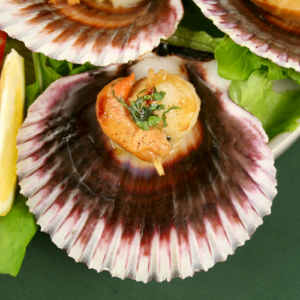
Since sea scallops die out of water, they are always shucked at sea and kept on ice, if not frozen aboard.
Product Profile
The largest commercially available scallops, sea scallops have a sweet, rich taste that ranges from mild to briny. Scallops are generally less susceptible to contamination than other shellfish, primarily because normally only the well-guarded adductor muscle is eaten. However, person in high-risk health categories should not eat it raw.
Nutrition facts:
Serving size: 100 g/3.5 oz. (raw)
Amount per serving
| Calories | 87 |
| Fat Calories | 7 |
| Total Fat | 0.8 g |
| Saturated Fat | 0.1 g |
| Cholesterol | 36 mg |
| Sodium | 87 mg |
| Protein | 16.2 g |
| Omega-3 | 0.2 g |
Cooking tips:
Though they may be large, sea scallops have to be cooked quickly. Recipes often suggest cutting them in half across the grain before cooking, but the large size makes sea scallops a natural for the grill. Don’t microwave scallops- they can explode at higher heat.